Archive | January, 2012

Join us in congratulating UCOP “stars” honored Jan. 25

Join us in congratulating UCOP “stars” honored Jan. 25

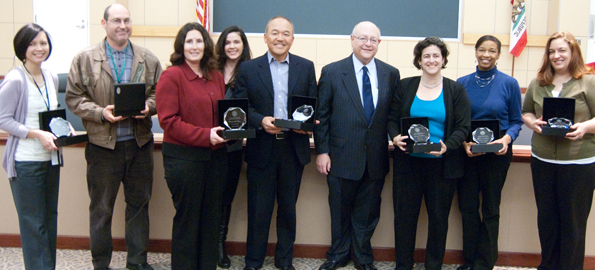
UCOP held its semi-annual Service Award Milestone event Jan. 25 at the Elihu Harris State Office Building, adding to the tradition by announcing the inaugural recipients of OP’s new Innovation and Impact Awards.

President Mark Yudof, EVP Nathan Brostrom and VP Dwaine Duckett recognized 64 UCOP employees who have served the university for 10, 15, 20, 25 and 30 years. They also spotlighted 18 winners of the Impact Awards, OP’s new annual honor recognizing exceptional individual and team contributions in three categories.

In introductory remarks, President Yudof said he was proud of UC’s long-serving and exemplary staff, upon whom the “stardom” of UC depends in its service to both the university and the people of California.

VP Duckett explained that the new awards program, overseen by UCOP Local Human Resources, is an idea he had been wanting to institute since coming to UC. All levels of staff except senior leaders are eligible for the Innovation and Impact Awards, and any OP employee can submit a nomination.

A total of 38 nominations for individual and team awards were received in the three award categories, representing a wide range of achievement from across UCOP.

Nominations were reviewed by a selection committee of representatives from the Black Staff and Faculty Organization, the Latino Staff Association, the OP Climate Committee, the OP Staff Assembly, the President’s Advisory Committee on the Status of Women, UCOP Pride (formerly the LGBTISA) and the Young Professionals Association; the committee’s recommendations were then reviewed by President Yudof.

EVP Brostrom announced the awardees — six individuals and two teams — for their innovation and impact and called each honoree forward to receive the awards. The honorees, listed in their award categories, were:

Connecting with the Community

The first award category recognizes individual volunteer effort or active service in a nonprofit community-based organization resulting in a meaningful impact on the local community or its residents:

  • George Zamora (Student Affairs) for his active leadership in the Chicano Latino Alumni Association, including fundraising and organizing activities in support of nearly 100 scholarships to undocumented UC Berkeley students and CSAA scholarship opportunities for Asian students.
  • Barbara Jim-George (Business Resources Center) for her work developing education and life skills programs for at-risk teen girls in Oakland to help them avoid becoming victims of human trafficking. She developed a Girl’s Rite of Passage Program as a thesis project for her Master of Divinity and continues this research in pursuit of her doctorate.
  • A team award goes to John Mortimer (HIV/AIDS Research Office), Phillip Gardiner (Tobacco Research), Senaida Fernandez and Marion Kavanaugh-Lynch (Breast Cancer Research) for their outreach efforts to engage community members and organizations in research to improve their communities. These individuals have made it their own personal mission to bring research to bear in very real ways across California.

Modeling OP Culture and Principles

The second award category recognizes someone who strives to uphold UCOP’s principles of community, demonstrating commitment to and/or promotion of service and stewardship; inclusion of and respect for different viewpoints; dedication to making positive change, especially in the area of morale; and positive influence on managers, peers, supervisors, subordinates and the UCOP community.

Ginny Cox Delaney (Research Grants Programs Office) was honored for her critical leadership in the reorganization of RGPO, which included collaborating with other unit leaders to produce tools for improving work quality, coordinating training to improve working together as well as overall culture and climate.

Advancing the Mission

The third award category recognizes extraordinary leadership resulting in the accomplishment of significant goals or work products that serve the good of UC and/or the Office of the President:

  • Paul Weiss (Information Technology Services) for his contribution to developing the Technology Asset Management Program and the new IT Project Office, partnering with UCSF on disaster recovery, and encouraging innovation and customer service within his department. Paul emphasized that all these achievements required a team effort.
  • Dragana Nikolajevic (Research Policy Analysis and Coordination) for developing a new Reliance Registry web tool for leveraging the collective research power of all 10 UC campuses and Lawrence Berkeley Lab. Her work will facilitate the approval process for multicampus human subject research, making it more efficient and less burdensome for researchers, and thereby advancing the mission.
  • Jayne Dickson (California Digital Library) for her work in developing and maintaining Frequently Asked Questions and other user support tools for the new Melvyl Catalog platform for UC Libraries. The Melvyl Catalog includes content libraries worldwide as well as UC Libraries, including millions of research articles across all disciplines. Jayne played a leadership role in educating library staff and researchers about the new platform, providing a model for user support.
  • A team award was given to Bart Aoki, Julia Arno, Katherine McKenzie, Peter Agron, Karen Wirthlin, Stella Ngai, Luanna Putney and Ellen Auriti. This cross-functional Center of Excellence team representing ORGS, the Office of General Counsel and the Office of Ethics, Compliance and Audit developed a new Conflict of Interest and Professional Activities Policy, along with training and a conflict disclosure and monitoring program. The team went far above and beyond their initial charge and produced tangible results that serve to advance the mission. The team produced a policy and implementation process that establishes higher standards of conduct for UCOP employees engaged in managing research funds and promoting research.

Please join us in congratulating these long-serving and exemplary UCOP staff for their dedication and service!

CATEGORY: OP HeadlinesComments (0)

UC explores restorative justice in improving campus climate

UC explores restorative justice in improving campus climate

A residence hall fire alarm is pulled as a drunken prank in the middle of the night. A fellow resident, who happens to be gay, witnesses it and confronts the culprit as the building is evacuated. In the exchange of words, the prankster utters a pejorative term for a homosexual man in a profanity-laced tirade.

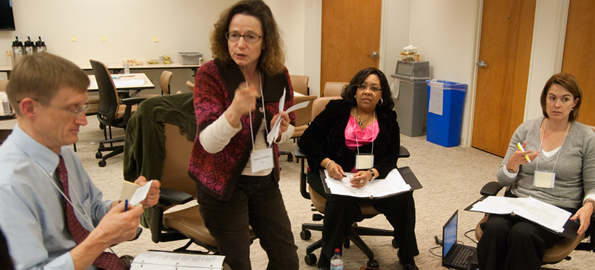
Fortunately, the situation was just part of a role-playing exercise. Twenty-three student affairs staff members, from all 10 University of California campuses, took part in training for restorative justice, a conflict resolution process that UC is considering for use when dealing with incidents of intolerance or hate, particularly for conduct that, while offensive, may not violate any laws or policies.

The two-day training session at UCOP offered participants guidance in facilitating and implementing restorative justice in a campus community. The safety and engagement workgroup of President Mark Yudof’s Advisory Council on Campus Climate and the UC Student Association recommended an exploration by UC in implementing restorative justice at all its campuses.

Restorative justice provides “opportunities for education and dialog when addressing (campus climate) incidents, and these are opportunities we cannot afford to miss,” Yudof said in opening remarks for the training session on Thursday, Jan. 26.

Restorative justice is a collaborative, victim-offender reconciliation process developed for criminal cases but is being implemented by many universities for use in dealing with student conduct incidents.

Campus climate came into focus at UC during the past two years after a series of highly charged racial, religious and cultural incidents on some campuses.

When these incidents occur at universities, administrators often are put in the precarious position of trying to balance the right to free speech while also striving to create a campus climate that is positive and inclusive.

“Not every wrong has a legal remedy. Students may say things that are hurtful to members of our campus community,” Yudof said. “Hurtful speech may be constitutionally protected and not subject to student discipline codes, but it’s still a wrong and still offends some in our community.”

The training was facilitated by David Karp, the associate dean of student affairs at Skidmore College, who is the author of Restorative Justice on the College Campus and a national authority on using the process in higher education. Co-facilitating was Duke Fisher, founder of Learning Laboratories, which provides training in restorative justice and conflict resolution.

“The core of it is about learning,” Karp said of the concept. “It’s an education process. We want students to be able to learn from their mistakes in a way that expresses the values of the institution.”

Restorative justice has been used in about 20 instances since 2002 at UC Santa Barbara and was used in one case at UCLA in 1999. A student group at the UC Berkeley School of Law has been providing restorative justice training on campus.

A central component of restorative justice is a facilitated discussion with all parties involved. Each person discusses how they were harmed or harmed others in an open dialogue. Offending parties must take responsibility for their actions. The goal for the group is to devise a way for the offending party to repair the harm while regaining trust and rebuilding relationships.

During the training session, participants held a mock facilitated session in the aftermath of the fire alarm incident. The prankster acknowledged an alcohol problem and how his actions impacted people. Other roles included his gay neighbor and other dorm residents. Group members explained how the incident affected them and offered suggestions to make amends, such as alcohol counseling.

If it were a real restorative justice mediation at a university, any remedies would have to be agreed upon by the group and campus administration.

The process may not be feasible for every situation, and people have to be willing participants for it to work. Nevertheless, restorative justice can be a useful tool in a university setting, said Laura Butler, the coordinator for leadership and judicial affairs in the Office of Student Life at UC Merced, who took part in the training.

“Conflict mediation is empowering,” Butler said. “We need to have more dialogue. I believe in the power of words and the concept of mediation.”

CATEGORY: UC In The NewsComments (0)

UC leads academic institutions in green building standards

UC leads academic institutions in green building standards

UC is saving $32 million a year on energy and remains the leader in higher education for adopting green building standards.

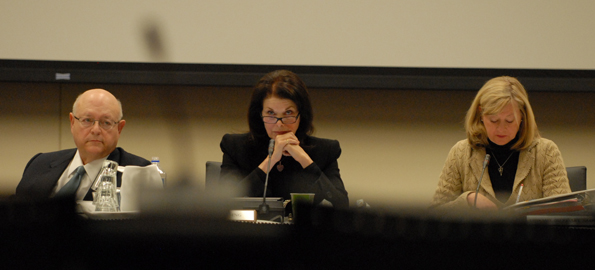
Those achievements and others were outlined in the 2011 UC Annual Report on Sustainable Practices at the Board of Regents meeting at UC Riverside on Jan. 18.

The UC system added 38 LEED-green certified facilities during 2011 and now has 87, which continues to be the most of any university in the country, according to the annual report.

Much of UC’s $32 million in annual savings in energy use, up from $21 million in 2010, comes from participation in an Energy Efficiency Partnership with the California State University, California Community Colleges and the state’s investor-owned utility companies.

Since the partnership’s inception in 2004, UC has received $47.5 million in grants, which it coupled with more than $150 million in campus contributions and some external financing to fund energy efficiency projects. The projects include retrofitting lighting, heating, ventilation and air conditioning systems to be more energy efficient.

“Energy efficiency is a cornerstone of UC’s sustainability efforts,” said Nathan Brostrom, UC’s vice president for business operations, who presented the annual report to the regents. “Going green is the smart thing to do. These projects reduce energy use and cut costs while improving the comfort, health and safety of UC facilities.”

UC’s energy conservation efforts are among the key UC Working Smarter administrative efficiency initiatives.

The energy reductions achieved have kept roughly 168,000 metric tons of greenhouse gases from being released, equal to approximately 10 percent of UC’s 2010 carbon footprint.

UC’s Policy on Sustainable Practices guides campuses in the areas of green building, clean energy, sustainable transportation, climate protection, sustainable operations, waste reduction and recycling, environmentally preferable purchasing and sustainable food service. In 2012, UC is studying the possibility of adding water conservation and storm water management as a ninth area of coverage for its sustainability policy.

Even as more colleges and universities embrace sustainability, UC continues to be recognized as a national leader. In 2011, UC campuses and facilities received 12 national and state awards and continue to be recognized in the top tiers of national campus sustainability rankings. UC also has received national media acclaim in publications such as New York Times, Forbes, and in television and radio news broadcasts.

See the complete story by Harry Mok, principal editor in the UCOP Integrated Communications group, on the UC Newsroom website.

CATEGORY: UC In The NewsComments (0)

UC Global Health Day to focus on population growth

UC Global Health Day to focus on population growth

More than 300 people — many of them UC faculty, students and staff — will gather at UC Berkeley on Saturday, Feb. 4, for the second UC Global Health Day, sponsored by the UC Global Health Institute (UCGHI). The conference will be both a discussion about population growth and its impact on health worldwide, and a showcase for global health research being undertaken by graduate students, postdoctoral fellows and junior faculty across the 10-campus system.

The conference, from 8:30 a.m. to 5 p.m. in Dwinelle Hall, will be hosted in partnership with the UC Berkeley Center for Global Public Health, the UC Berkeley Bixby Center for Population, Health & Sustainability, and the Northern California International Health Interest Group.

Two special sessions will take place in the morning with prominent speakers from the U.S. and abroad. The first session, Population, Consumption and Human Wellbeing, will be chaired by UC Berkeley’s Malcolm Potts, director and founder of the Bixby Center for Population, Health & Sustainability. The session will feature keynote speaker Sir John E. Sulston, the 2002 Nobel laureate in medicine. He chairs the People and the Planet Working Group of the Royal Society, London. Potts and Eliya Msiyaphazi Zulu, the second keynote speaker, also are participants in the working group.

“The freedom and autonomy of women, the challenge of reducing maternal and infant mortality around the world, lifting 2 billion people out of abject poverty, forestalling more failed states like Somalia, and adapting to global warming are all heavily influenced by the population growth factor,” said Potts. “Whether women are given the right to decide when to have a child is critical to health as well as education and development.”

A second morning session, titled Consequences of High Fertility and Population Growth: The Special Case of Africa, will be chaired by UC Berkeley’s Martha Campbell, lecturer in global health, School of Public Health. The keynote speaker will be Zulu, director of the African Institute for Development Policy in Nairobi, Kenya. Both morning sessions also will feature prominent scientists from several UC campuses.

“The future of many African nations hinges on the policies that African governments develop and the investment the international community is prepared to make around voluntary family planning,” said Campbell.

In the afternoon, more than 70 UC students, faculty and other practitioners in global health will make oral presentations and lead breakout sessions, and 78 posters will be presented. A range of global health issues will be offered, including: Global Public Health Law; Global Health & the Media; Gender-based Violence in sub-Saharan Africa: Toward a Transdisciplinary Approach; Social Media How-To; From Malaria Control to Elimination; Improved Childhood Health through Reduction of Household Air Pollution from Cookstoves; and Climate Change & Vector Biology.

“Students and young faculty are the main drivers behind the incredible growth in global health research and education programs on UC campuses,” says Haile Debas, director of the UC Global Health Institute and former chancellor and dean of the School of Medicine at UCSF. “UC Global Health Day provides a forum to share their research and ignite collaborations that could lead to innovations in addressing major health problems in developing countries.”

The UC Global Health Institute was established in November 2009 in response to the growing demand from students and faculty interested in global health research and education. The UCGHI is composed of three multicampus Centers of Expertise — Migration & Health; One Health; and Women’s Health & Empowerment – that are launching projects and education and training programs to produce leaders and practitioners of global health, conduct innovative research, and develop international partnerships to improve the health of vulnerable people and communities in California and worldwide. Currently, the UCGHI is assessing the feasibility of creating a joint MS program in global health at three or more UC campuses.

The UCGHI is jointly led by Debas at UCSF and Thomas Coates, the Michael and Sue Steinberg Professor of Global AIDS Research at the UCLA David Geffen School of Medicine.

CATEGORY: UC In The NewsComments (0)

advert

Event Calendar

<<   May 2013   >>
S M T W T F S
30 1 2 34
56 7 8 910 11
1213 1415 16 1718
19 20 21 22 232425
26 27 28 29 30 31

Connect with UC

UC for California   Follow Mark Yudof on Twitter   Follow Mark Yudof on Facebook

Archives