Archive | March, 2012

Berkeley’s Geoff Marcy brings the Kepler expedition to life for UCOP

Berkeley’s Geoff Marcy brings the Kepler expedition to life for UCOP

You’ve heard about Kepler, the space-borne telescope that has revealed hundreds of exoplanets, planets outside our solar system revolving around their own suns.

But did you know that one of the minds behind Team Kepler is right here at UC, an alum of UCLA and UC Santa Cruz, professor of astronomy at UC Berkeley and director of Berkeley’s Center for Integrative Planetary Science?

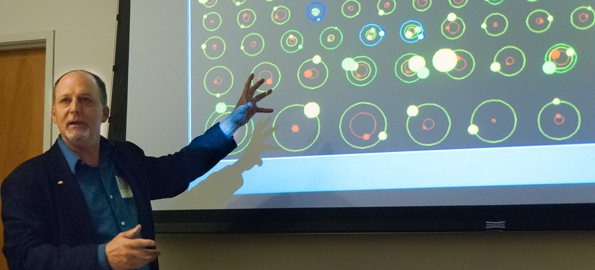
He is Geoff Marcy, and despite his rock star status in the world of astrophysics, he sometimes acts like a little kid in a toy store when he gets talking about Kepler and its findings. Which is exactly what he did at UCOP for 60 star-studded minutes in his March 16 talk, “The Hunt for Another Earth,” part of the President’s Speaker Series.

“This is an amazing moment in science history,” Marcy said, animatedly narrating a slide show full of time-lapse charts, home video, artists’ renderings of new planets and other celestial treats. “We’re in an incredible era where we can study systems of multiple stars and planets and ask, ‘How does our solar system fit in?’”

Describing the diversity of planet types out there — rocky, gaseous, giant waterworlds, and how they compare with the planet we know best — he speculated whether some of them might harbor microbes or even intelligent, “technological” life.

“The human connection to this science is so compelling,” Marcy said. “The galaxy might be teeming with life, but where is everybody? Why haven’t they found us?”

Kepler, a 95-megapixel telescope with a 10 X 10-degree field of view, can measure brightness to within 0.01 percent. As sophisticated as the instrument is, the science behind it is simple, Marcy explained.

When Kepler, trained on a particular star, visualizes a blot that moves across that star along a plane and follows a cyclical pattern, a planet is revealed. The frequency of its cycle reveals the planet’s orbital period, and the amount of dimming of the star reveals the planet’s size.

“The beauty of this telescope is that you can get data 24/7,” he added, data so granular that a given planet’s density can also be extrapolated. Kepler is yielding a wealth of information about thousands of planets, despite the fact that “we have absolutely no idea what these planets actually look like,” Marcy said.

His home video footage of the March 2009 Kepler launch from Kennedy Space Center — accompanied by squeals and shouts of “You go, baby!” from the 25 or so colleagues who shared the moment — was one of the highlights of the talk. The team was naturally excited, Marcy explained, but had been apprehensive about the mission’s success due to the failure a few weeks before of NASA’s Orbiting Carbon Observatory (OCO) mission just 17 minutes into its launch.

Another highlight was the Kepler Orrery, recently created by Marcy’s colleague D. Fabrycky, an animated graphic illustrating the hundreds of multiple-planet systems Kepler has discovered so far. The dizzying array of tiny balls spinning at various speeds around multiple solar systems makes you feel minuscule indeed.

With all those planets out there, what are the chances that some of them support intelligent life? There are several possible explanations for why we have not yet encountered even one, despite our efforts, Marcy posited.

“Microbial life is probably common, but intelligence is probably rare,” Marcy said. “We like to think of ourselves as representing the pinnacle of Darwinian evolution, but does evolution favor intelligence?” The dinosaur, with its walnut-sized brain, and the cockroach, with its primitive nervous system, Marcy suggested, are just two examples of how lower forms of intelligence can still possess prodigious survival skills.

The President’s Speaker Series, “On California,” was initiated by President Mark Yudof last year to showcase the talent and public contributions of UC faculty, alumni and other prominent Californians in the areas of education, policy/politics and research.

Upcoming speakers include:

  • Thursday, April 19: Russell Rumberger, Vice Provost, Education Partnerships, and author of Dropping Out: Why Students Drop Out of High School and What Can Be Done About It
  • Thursday, May 3: Haile T. Debas, M.D., Director, UC Global Health Institute, and former chancellor, UCSF, and dean, UCSF School of Medicine

All events take place 12 to 1 p.m. in Franklin’s Lobby One Conference Room.

CATEGORY: OP HeadlinesComments (1)

UC Health’s community benefit tops $3 billion

UC Health’s community benefit tops $3 billion

For the first time, UC Health has measured the collective impact it has in caring for uninsured patients, educating tomorrow’s health leaders and advancing science to tackle medicine’s toughest challenges.

The estimated community benefit of UC Health’s five medical centers totaled $3.3 billion last year.

“As a public university and cornerstone of the safety net, UC Health is committed to serve California’s health needs,” said Dr. John Stobo, UC senior vice president for health sciences and services. “Our combined community benefit demonstrates the powerful impact UC Health has as a system.”

Throughout UC Health, student-run clinics collaborate across their campuses and within their communities to treat patients from the working poor to the homeless and their pets. UC’s three nurse-run clinics provide compassionate care to underserved patients in Los Angeles, Orange County and San Francisco. UC’s innovative Programs in Medical Education (PRIME) train doctors where they are most needed with programs focused on rural health and telemedicine (UC Davis), the Latino community (UC Irvine), the diverse disadvantaged (UCLA, UC Riverside), the San Joaquin Valley (UC Merced, UC Davis, UCSF), health equity (UC San Diego) and the urban underserved (UCSF, UC Berkeley).

UC Health has the nation’s largest health sciences educational system, with 18 professional schools and programs on seven campuses. Its community impact is felt in all corners of the state, through telemedicine services, clinical trials, classroom collaborations and affiliations such as UCLA’s partnership with the Venice Family Clinic, the nation’s largest free clinic.

Community benefits include programs or activities that improve access to care, enhance community health, advance medical knowledge and reduce the burden of government or other community efforts.

Here is a breakdown of UC Health’s community benefit in fiscal 2011, with totals from the health sciences campuses that have medical centers — UC Davis, UC Irvine, UCLA, UC San Diego and UCSF:

  • Charity care and unreimbursed care: $560.7 million. Free medical services for patients who had no source of payment for urgently needed care and the unpaid cost of Medicare, Medi-Cal, State Children’s Health Insurance Program, indigent care programs and other safety net programs.
  • Education: $174.7 million. Health professions education encompasses teaching physicians, nurses and students as well as scholarships and funding for education.
  • Donations/sponsorships: $1.8 million. Through financial and in-kind contributions, UC Health offers support to community organizations to improve community health.
  • Research: $2.6 billion. UC research gives local residents access to the latest treatments and therapies for advanced illness and complex health conditions.

For more information, see the following resources:

CATEGORY: UC In The NewsComments (0)

Off the clock with Keohi Council of Student Affairs

Off the clock with Keohi Council of Student Affairs

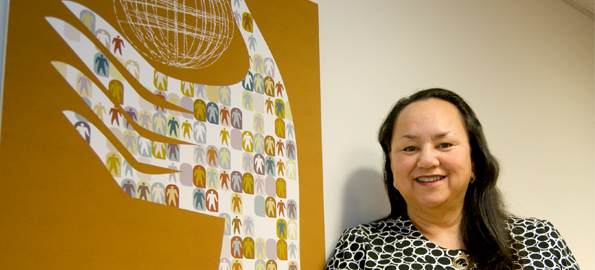
As a mother of three, grandmother of eight, and someone who used to dance hula in performances with her dad and other relatives, it’s not surprising that Keohi Council’s guiding principle is the Hawaiian concept of ohana.

“Ohana is about family, community, the welcoming and inclusive spirit,” the Honolulu native says. “It’s a big part of why I came to UCOP.”

Council’s own 30-plus-year career took her from Cal State to Virginia Tech and UC Davis before she made a soft landing at UCOP, where her colleagues say she approaches her work with calm, caring and professionalism.

In fact, Council has spent a large part of her “free” time for the last seven years learning how to do her job better through the International Association of Administrative Professionals (IAAP), which offers education and leadership opportunities to administrative professionals worldwide.

She joined UCOP in 2009 and is now executive secretary to Student Affairs Vice President Judy Sakaki, whose career she had followed since the two first met at Cal State East Bay (then Cal State Hayward) in the early 1980s.

“One of the things that makes OP exciting and challenging is that you never know what each day will bring,” Sakaki says. “But Keohi has a calmness about her; she is a reliable, steady force, and that’s a very strong quality in the workplace.”

Council is this year’s president of IAAP’s TriCity chapter, serving Fremont, Union City and Newark. She spends several weeknights and about one weekend day each month organizing meetings, planning educational programs, writing articles, networking and keeping up her skills for IAAP certifications, of which she holds two. She has also qualified as a 2011–12 member of excellence, IAAP’s elite category for members who participate at the highest level.

“You work on a broad range of things – organizational skills, time management, office systems and technology applications like Word and Excel – and you have to recertify every five years,” Council explains. “When I took my first exam I already had 25 years of experience, but I still felt I had to study really hard.”

The IAAP provides unlimited opportunities for networking, mentoring and professional development, which not only add to Council’s skills but also her job maturity. “It puts her in a position where she is providing leadership,” Sakaki says.

As Sakaki’s executive secretary, Council provides support in the areas of student services, student financial support and undergraduate admissions, working closely with student affairs offices on all 10 campuses, the UC Staff Association and student policies governing such things as use of technology, privacy and safety issues.

Safety is an area that hits close to home: Council was at Virginia Tech, working as office manager for the Provost’s Office, when the April 16, 2007, shooting occurred across the walkway from her office. The deadliest shooting by a single gunman in U.S. history, it ended in the deaths of five faculty and 28 students.

“The shooting put things in perspective for me,” Council says. “I was missing out on my grandchildren growing up and wanted to spend more time with my family.” So she moved back to California in late 2007, coming full circle when she joined Sakaki’s staff.

In her native language, her name — Keohiokalani — stands for eldest beloved child of the beautiful heavens. Handed down to her from her great grandmother and in turn to her daughter and two granddaughters, the name is a fitting one for this gentle and caring woman.

“So much is happening here at UCOP, and it’s important to keep the vice president up to date with the most current information,” Council says. “I try to bring a calming presence to the whole unit.”

CATEGORY: In ProfileComments (0)

Alfredo Terrazas speaks March 27 for Cesar Chavez Day

Alfredo Terrazas speaks March 27 for Cesar Chavez Day

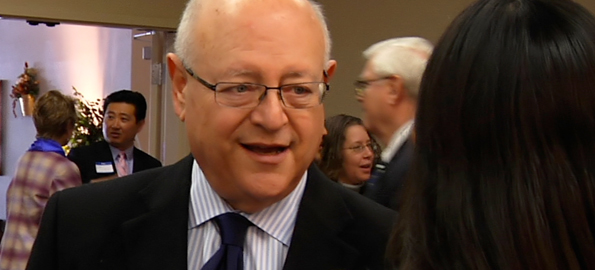
Commemorate the birthday of César Chávez on Tuesday, March 27, 12:10 to 1 p.m., when Berkeley alumnus and Senior Assistant Attorney General Alfredo Terrazas visits UCOP in Franklin’s Lobby One Conference Room.

Terrazas has served under several California attorneys general, including George Deukmejian, John Van de Kamp, Dan Lungren, Bill Lockyer, Jerry Brown and Kamala Harris. He is currently senior assistant attorney general in charge of the Licensing Litigation Section, where he oversees 100 deputies and paralegals in the largest statewide section in the Division of Civil Law.

As a community leader, his volunteer and advocacy work includes service on the boards of the United Way of the Bay Area, the East Bay Community Foundation and the UC Berkeley Foundation, where he still serves as an advisory trustee. Terrazas is also a UC regent emeritus and former president of the California Alumni Association. He holds a B.A. in Spanish from UC Berkeley and a law degree from Santa Clara University School of Law.

Refreshments will be served following the program, which is cosponsored by the Latino Staff Association of the University of California and UCOP Human Resources.

César Chávez was cofounder and president of the United Farm Workers of America, AFL-CIO. His birthday, March 31, is celebrated in California as a state holiday, and UCOP offices will be closed on Friday, March 30, in honor of the holiday.

CATEGORY: OP HeadlinesComments (0)

advert

Event Calendar

<<   May 2013   >>
S M T W T F S
30 1 2 34
56 7 8 910 11
1213 1415 16 1718
19 20 21 22 232425
26 27 28 29 30 31

Connect with UC

UC for California   Follow Mark Yudof on Twitter   Follow Mark Yudof on Facebook

Archives