Archive | April, 2012

Reminder: Best Practices “Salon” at Kaiser April 26

Reminder: Best Practices “Salon” at Kaiser April 26

Don’t forget about the new Best Practices “Salon,” held 12 to 1 p.m. in the Kaiser Building every other Thursday to inspire lively discussions about best practices in fields relevant to work being done at UCOP.

The next salon will be held Thursday, April 26, in the Kaiser 6th floor lobby area. The role of facilitator rotates each session, with the selected individual choosing an article or topic as a basis for the next discussion. This Thursday’s springboard for discussion is The Economist’s April 14 story about Honeywell International.

What is a salon, you ask? No cut and color, no shampoo or blow dry. This kind of salon, according to Wikipedia’s definition, is “a gathering of people under the roof of an inspiring host  . . . to increase knowledge . . . through conversation.”

Started by HR Principal Analyst Maura McLoughlin and Benefits Education Manager Bill Ryan, the goal is to engage colleagues in lively discussion, to share thoughts, opinions and analysis, and thereby increase the collective knowledge at UCOP. McLoughlin and Ryan hope that discussions will inspire people with new ideas that they can use to improve their work at UCOP.

Discussion topics could cover anything from higher education to human resources, innovation, leadership and management, but should remain broad to encourage wide participation. Previous meetings have been based on the following:

Each session begins with a review of the chosen article, followed by a 30-minute discussion led by the facilitator. Participants then identify the next voluntary facilitator and also have time to eat lunch.

If you’re curious, just show up at the next salon on April 26. Or contact Maura McLoughlin at maura.mcloughlin@ucop.edu or Bill Ryan at william.ryan@ucop.edu for more details.

CATEGORY: Open ForumComments (0)

Toxicity lingers after tobacco smoke clears, UC research program finds

Toxicity lingers after tobacco smoke clears, UC research program finds

Thirdhand smoke is a new frontier, and UC’s Tobacco-Related Disease Research Program has assembled a consortium of investigators to study the health risks caused by the remnants of cigarette smoke.

The stale smell of cigarette smoke moves many a traveler to request a smoke-free hotel room. Who wants to smell someone else’s bad habit? But the lingering odor may be telling us something else — something more troubling.

Research funded by the UC-run Tobacco-Related Disease Research Program (TRDRP) shows that long after smoke has cleared from a room, toxic pollutants from cigarette smoke adhere to bedspreads, carpets, clothing — even furniture, walls, ventilation systems and hallways of hotels that allow smoking. Similar toxicants cling to surfaces in rental cars driven by smokers.

Byproducts of cigarette burning produce potent carcinogens when they combine with common indoor compounds. Many can remain in rooms for months.

“In the 1950s, we found that smoking could kill you; then research in the ’80s and ’90s showed that secondhand smoke is dangerous,” said Georg Matt, a psychology professor of at San Diego State University who focuses on policies to protect nonsmokers.

“The potential health risks of what we call thirdhand smoke are only now being studied. This is a new frontier.”

Matt is a member of the Cancer Prevention and Control Program at UC San Diego and an investigator in a new thirdhand smoke research effort by the TRDRP.

The TRDRP funded the research consortium in 2011 to bring together experts in a range of fields, from toxicology and chemistry to behavioral and policy research, in order to determine the scope of thirdhand smoke risk and help develop policies to protect people where needed.

Consortium researchers presented their findings on thirdhand smoke at the  “Linking Tobacco Control Research and Practice for a Healthier California” conference held April 10-12 in Sacramento. The conference was sponsored by TRDRP and the state’s Tobacco Control Program.

“We don’t yet know the degree of risk, but we are already finding that indoor smoking leaves a nearly indelible imprint,” Matt said. “We need to find out what risk this pollution poses.”

Risks to infants and toddlers are of particular concern to consortium scientists. Young children crawl on rugs and carpets and often put their hands in their mouths. They have more contact with pollutants that cling to surfaces in the home.

An infant’s developing brain is very susceptible to low levels of toxins, and immature immune systems are particularly vulnerable to persistent pollutants. Researchers suspect that children with respiratory diseases like asthma are likely to be at highest risk.

“This is a newly emerging concern, but one we think is very important to study,” said Anwer Mujeeb, program officer for TRDRP’s thirdhand smoke research effort. “We are leading the way in research to learn how these pollutants form, how long they remain and how they interact. Of course, it’s critical to determine at what concentrations they pose a threat to health.”

TRDRP is funded by California state cigarette taxes and managed by UC. The program launched the thirdhand smoke research consortium with $3.35 million to support a range of investigations.

“We’re very fortunate to have in California scientists who are already making an impact in tobacco research,” said Mujeeb. “The research goes hand in hand with efforts to reduce the number of people who take up smoking in the first place.”

For Wallace Ravven’s complete story, including video, go to the UC Research website.

CATEGORY: UC In The NewsComments (0)

Solving the “dropout crisis” is critical for state, Vice Provost Rumberger says

Solving the “dropout crisis” is critical for state, Vice Provost Rumberger says

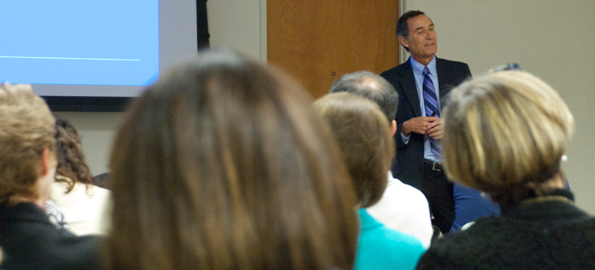
Dropping out of high school is a “severe” problem that costs California an estimated $19.5 billion every year, said Russ Rumberger, vice provost for education partnerships, in an April 19 appearance at UCOP, part of the President’s Speaker Series.

“Each student is a story, so it’s hard to generalize,” he said, admitting that identifying the true causes of dropping out is a complex exercise.

But understanding what contributes to a student’s growing disillusionment, recognizing early predictors in at-risk students, and identifying attitudes and behaviors that lead to dropping out are critical to addressing the problem.

Rumberger’s talk centered around his book, Dropping Out: Why Students Drop Out of High School and What Can Be Done About It, published last year by Harvard University Press and described as a “masterpiece” by Washington Post education columnist Jay Mathews.

“I wrote my first paper on this topic 30 years ago,” Rumberger said. “I was worried about this group at the bottom of the educational distribution, which suffers greatly in any society — the group that is poorly educated.”

Rumberger is a professor in the Gevirtz Graduate School of Education at UC Santa Barbara. He is founding director of the California Dropout Research Project (CDRP), which developed a policy agenda to improve the state’s high school graduation rate. Since the CDRP’s inception in 2006, three pieces of legislation based on its recommendations have been signed into law to address what Rumberger calls “the dropout crisis.”

California’s dropout rate of roughly 25 percent has dire consequences for the state both economically and socially, Rumberger said. He estimated the cost in dollars based on these metrics:

  • Dropouts are more likely to be poor, with lower wages, higher unemployment and reduced tax contributions.
  • Dropouts commit more crimes and have reduced political participation and intergenerational mobility.
  • Dropouts have poorer health and a lower life expectancy by nine years than those who graduate from high school.

“Every time a kid fails a class, it raises his chances of dropping out,” Rumberger said. Other causes include time missed from school, low educational aspirations, family and mobility issues, and misbehavior; and causes vary widely by families, communities and schools as well as demographics like language, ethnicity and socioeconomic status.

There is no single solution, Rumberger said. Past successful strategies range from programmatic solutions focusing on the student to comprehensive school reform and policy changes. But intervention must start early, using strategies such as smaller class sizes in grades K–3, since the process of dropping out begins well before a student even enters high school.

Rumberger also advocates fresh approaches that essentially redefine what it means to be successful in high school, like establishing personalized learning environments and emphasizing not just reading, writing and arithmetic, but also non-cognitive skills such as motivation and trustworthiness.

“If we redesign high school so that every kid could achieve competence in something — whether it’s math or building a house — we could fundamentally address this problem,” Rumberger said.

UC and other research universities have a critical role in the solution to the dropout crisis by supporting K–12 education, especially for underrepresented students, to enhance the pipeline to bachelor’s degrees and the workforce, Rumberger said. This is the work he does as vice provost for education partnerships at UCOP.

You can purchase Dropping Out online or download the first chapter for free. If you purchase the book and would like him to sign it, contact Gina Mortenson at gina.mortenson@ucop.edu.

The President’s Speaker Series, “On California,” was initiated by President Mark Yudof last year to showcase the talent and public contributions of UC faculty, alumni and other prominent Californians in the areas of education, policy/politics and research.

CATEGORY: OP HeadlinesComments (0)

Celebrate wellness at UCOP’s Wellness Fair Wednesday, May 2

Celebrate wellness at UCOP’s Wellness Fair Wednesday, May 2

Be sure to stop by UCOP’s Wellness Fair, coming to Franklin Lobby 1, 10 a.m. to 2 p.m. on Wednesday, May 2.

Several UC health and wellness vendors will be on hand, providing screenings, massage, giveaways and  information about the great programs and services they offer to keep you healthy. Here’s just a partial list:

  • Fidelity Financial Wellness: Retirement Counselor Joe Hager will explain Fidelity’s UC-customized offerings, including financial education workshops and the new UC Focus on Your Future website.
  • Health Net will conduct DermaScan screenings, a test that reveals skin condition and sun damage.
  • Kaiser Permanente will conduct blood pressure screenings, an important indicator of overall heart health.
  • Massage therapist Michael LaCroix, whose bodywork combines an orthopedic approach with Chinese medicine, will offer chair massages for $1 per minute.
  • UCOP’s Office of Environmental Health & Safety will talk about Be Smart About Safety, OP’s program offering sponsorship for projects that reduce loss in workers’ comp, liability, employment and other programs.
  • UCOP’s Office of Risk Services will be on hand to share information about its programs and services, from WorkFit to free training sessions in AED/CPR emergency response.
  • Michael Sands, M.D., offers a lunchtime lecture on Stress Reduction, 12 to 1 p.m. in 10325 Franklin.
  • Sittercity representative Jen Kraska will be available to answer questions about the web-based resource to help you find pre-screened in-home care for children, adults and pets, even tutors and housekeepers.
  • Vision Service Plan will collect outdated prescription eyeglasses for its Eyes of Hope donation program and hold a raffle for two pairs of designer sunglasses.

The event is sponsored by Wellness at UCOP.

CATEGORY: OP HeadlinesComments (0)

advert

Event Calendar